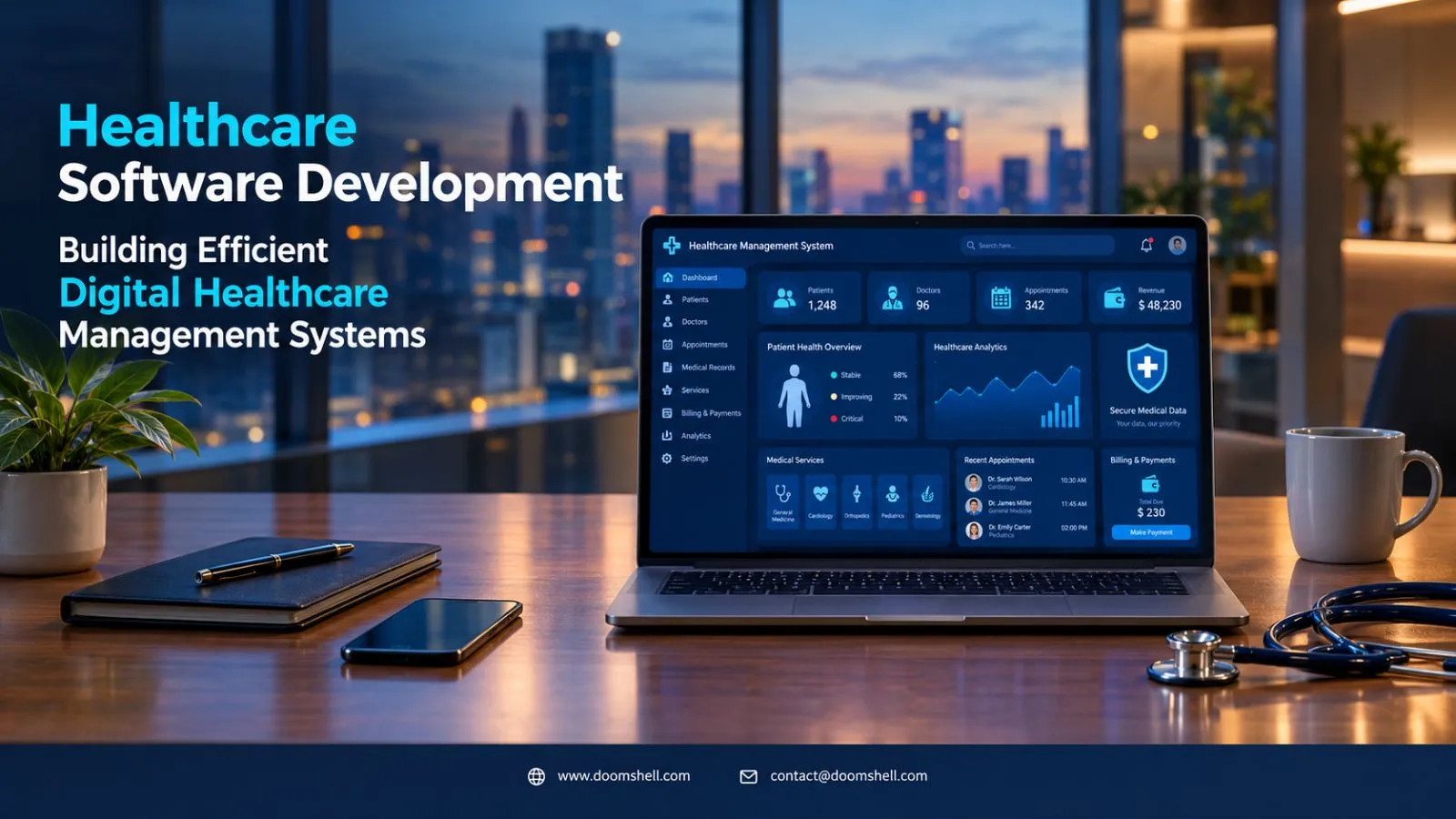
Modern healthcare management systems need to reduce manual administration while maintaining reliable data, secure access, interoperability, and efficient workflows across different departments.
In 2026, lightweight backend frameworks such as CodeIgniter can support healthcare applications that require structured business logic, database-driven workflows, REST APIs, and scalable integrations without unnecessary application complexity.
Building Healthcare Administration Portals
Healthcare administration involves many interconnected activities, from managing providers and patients to coordinating appointments, departments, records, and operational tasks.
A centralized healthcare management platform can bring these processes together and give staff a consistent view of administrative information.
Developing Healthcare Management Systems With CodeIgniter
CodeIgniter can provide a lightweight foundation for building database-driven healthcare administration systems.
A healthcare management application can include modules for:
-
Patient registration
-
Doctor and staff management
-
Appointment scheduling
-
Department management
-
Medical records
-
Billing workflows
-
Reports
-
Notifications
-
User administration
The framework's relatively lightweight architecture can be useful for organizations that want focused business applications without introducing unnecessary infrastructure complexity.
The application should still be designed around healthcare-specific requirements such as access control, auditability, data integrity, and privacy.
Creating Doctor and Staff Management Dashboards
Healthcare organizations need to coordinate doctors, nurses, receptionists, administrators, technicians, and other staff.
A staff dashboard can centralize information about schedules, departments, availability, responsibilities, and pending tasks.
For example, an administrator could view:
Staff availability → Today's appointments → Department workload → Pending tasks
Role-specific dashboards can prevent users from being overwhelmed by information that does not apply to their responsibilities.
A physician may need appointment and patient information, while an administrative user may primarily need scheduling and registration data.
Building Patient Administration Portals
Patient administration begins before a consultation and continues throughout the healthcare journey.
A digital patient administration portal can manage registration, demographic information, appointments, documents, communication preferences, and administrative history.
Online registration can allow patients to submit basic information before arriving at a facility. Staff can then validate the information and complete the registration workflow inside the same system.
This reduces repetitive data entry and creates a more consistent patient onboarding process.
Automating Healthcare Workflows
Healthcare administration includes many repetitive workflows that can benefit from automation.
The goal is not simply to replace paper forms with digital forms. A modern system should connect each workflow step so that information automatically moves to the appropriate department or user.
Managing Appointments With CodeIgniter
Appointment management can be built around provider availability, departments, appointment types, scheduling rules, cancellations, rescheduling, and reminders.
A CodeIgniter-based application can provide interfaces for patients, reception staff, doctors, and administrators while maintaining a centralized scheduling database.
A typical workflow might look like:
Patient request → Availability check → Appointment confirmation → Reminder → Check-in → Consultation → Follow-up
The backend should validate appointment availability before confirming a booking to prevent conflicting schedules.
Automated reminders can also reduce missed appointments while giving patients clear information about upcoming visits.
Automating Patient Registration Workflows
Digital registration can turn a multi-step administrative process into a guided workflow.
Patients can enter information through an online form, while the system validates required fields and identifies incomplete information.
After submission, the workflow can:
-
Create a registration record
-
Validate submitted information
-
Check for potential duplicate profiles
-
Route the record for staff verification
-
Create or update the patient profile
-
Trigger relevant notifications
This reduces manual processing while keeping human review where verification is necessary.
Creating Digital Medical Record Management
Digital medical record management requires careful separation between administrative and clinical information.
A healthcare application can organize authorized information around a patient's profile while maintaining structured records for encounters, documents, diagnoses, medications, test information, and other relevant data.
The system should maintain a history of important changes rather than silently overwriting records.
For healthcare organizations that exchange clinical information between systems, interoperability standards are also important. HL7 FHIR provides a standardized framework for representing and exchanging healthcare information through resources and APIs. (hl7.org)
A CodeIgniter application can integrate with FHIR-based services where appropriate while retaining its own administrative workflows.
Developing Healthcare Reporting Systems
Healthcare administrators need visibility into operational performance. Reports can help organizations understand appointment activity, registration volumes, department workloads, staff utilization, and other administrative metrics.
Building Custom Healthcare Reports With CodeIgniter
Custom reporting allows healthcare organizations to generate information based on their specific operational requirements.
Reports can cover:
-
Appointment volumes
-
Cancellation rates
-
Registration activity
-
Department workloads
-
Provider schedules
-
Patient visit trends
-
Administrative tasks
-
System activity
Rather than creating every report directly from live transactional queries, larger reporting workloads can be separated from day-to-day application operations.
This prevents complex reports from slowing down appointment booking or patient registration.
Creating Data-Driven Administrative Dashboards
Dashboards can turn operational data into quickly understandable indicators.
An administrator may need to see today's appointments, pending registrations, provider availability, department activity, and unresolved administrative tasks in one place.
A useful dashboard should prioritize exceptions and actions rather than simply displaying large numbers of metrics.
For example, highlighting an unusually high number of cancelled appointments can be more useful than displaying total appointments alone.
Dashboard data should also be filtered according to the user's role and authorization level.
Optimizing Database-Heavy Healthcare Applications
Healthcare management systems can accumulate large datasets over time.
Patient profiles, appointment histories, records, documents, audit events, billing information, and communication logs all contribute to database growth.
Performance optimization can include:
-
Proper database indexing
-
Query optimization
-
Pagination
-
Efficient joins
-
Caching
-
Background processing
-
Data archiving
-
Database monitoring
Data integrity is equally important. Healthcare systems should use appropriate constraints and transactions to prevent partial updates from leaving related records inconsistent.
For example, an appointment cancellation may need to update the appointment status, release a scheduling slot, record an audit event, and trigger a notification workflow.
These operations should be coordinated so that the system does not end up in an ambiguous state.
Integrating Healthcare Applications
Healthcare organizations frequently depend on multiple applications. Laboratory systems, electronic health record platforms, billing systems, pharmacies, imaging services, communication platforms, and patient-facing applications may all need to exchange information.
Building REST APIs With CodeIgniter
CodeIgniter provides RESTful API capabilities through its API-oriented features, including resource controllers, request handling, validation, and response formatting.
A healthcare API can expose controlled services for:
-
Patient information
-
Appointments
-
Providers
-
Administrative records
-
Notifications
-
Documents
-
Reporting data
API security should include authentication, authorization, validation, rate limiting, logging, and monitoring.
Sensitive healthcare resources should also use fine-grained authorization so that authenticated users cannot automatically access every patient or administrative record.
Connecting Healthcare Applications With Third-Party Services
Healthcare applications may need to connect with external services for:
-
Telehealth
-
Payment processing
-
Laboratory information
-
Identity verification
-
SMS and email notifications
-
Appointment reminders
-
Insurance workflows
-
Healthcare data exchange
An integration layer can prevent external service-specific logic from spreading throughout the application.
For example:
Healthcare Platform → Integration Layer → External Service → Validated Response
This approach makes third-party integrations easier to maintain and replace.
It also allows the application to normalize different response formats before they enter the core healthcare workflow.
Developing Secure Backend Systems With CodeIgniter
Security needs to be incorporated into every layer of a healthcare backend.
CodeIgniter includes security features such as CSRF protection, input validation, output escaping, encryption services, and security-related configuration options.
However, framework features alone do not make an application secure.
A production healthcare platform should also consider:
-
Strong authentication
-
Role-based authorization
-
Encryption in transit and at rest
-
Secure session management
-
Audit logging
-
Secure file storage
-
API access controls
-
Dependency management
-
Backup and recovery
-
Security monitoring
Authorization should be enforced on the backend for every sensitive operation. Hiding a button in the frontend is not sufficient protection if the corresponding API endpoint remains accessible.
Making Healthcare Administration More Intelligent
Healthcare administration is also becoming an area where AI and automation can complement conventional software.
Administrative applications can use AI-assisted features for document classification, information extraction, appointment communication, summarization, and workflow routing.
For example, an incoming administrative document could be classified automatically and routed to the correct department for review.
Similarly, an AI assistant could help authorized staff locate information across approved administrative sources.
These features should operate within the application's existing authentication and authorization model. AI access should not bypass the permissions that apply to normal users.
For workflows that affect patient care or sensitive administrative decisions, organizations should also define appropriate human-review processes.
Building Cloud-Ready Healthcare Management Platforms
Healthcare organizations may begin with a single clinic and eventually expand to multiple facilities or departments.
A cloud-ready architecture can support this growth by separating application services, databases, file storage, APIs, background workloads, and monitoring.
CodeIgniter applications can be deployed in modern cloud environments while using managed database, storage, networking, and monitoring services.
Scalability should be based on actual workloads. For example, appointment APIs may need consistent availability throughout the day, while reporting and data-processing jobs can run separately as background workloads.
This separation helps prevent heavy administrative reports or integrations from affecting patient-facing workflows.
Designing Healthcare Software for Interoperability
Interoperability is becoming increasingly important as healthcare organizations connect more applications.
FHIR provides standardized resources for exchanging healthcare information, while modern healthcare APIs can provide controlled access to those resources.
A healthcare administration platform can therefore be designed with an integration-ready architecture from the beginning.
Instead of building every external connection directly into core modules, the application can use dedicated integration services that translate external data into internal models.
This makes the platform easier to extend when an organization adds another hospital, laboratory, healthcare provider, or third-party service.
Conclusion
Healthcare software development is helping healthcare organizations replace fragmented administrative processes with connected digital management systems.
CodeIgniter can support healthcare administration platforms covering patient registration, doctor and staff management, appointments, medical record workflows, reporting, REST APIs, and third-party integrations.
The most effective systems go beyond digitizing individual tasks. They connect workflows so that registration, scheduling, records, reporting, communication, and integrations operate within a consistent and secure architecture.
FHIR-based interoperability, backend authorization, database optimization, cloud-ready infrastructure, and carefully governed AI features can further prepare healthcare applications for changing digital health requirements.
For hospitals, clinics, and healthcare businesses planning new management software, a modular and integration-ready architecture provides a practical foundation for improving administrative efficiency while supporting future digital healthcare services.