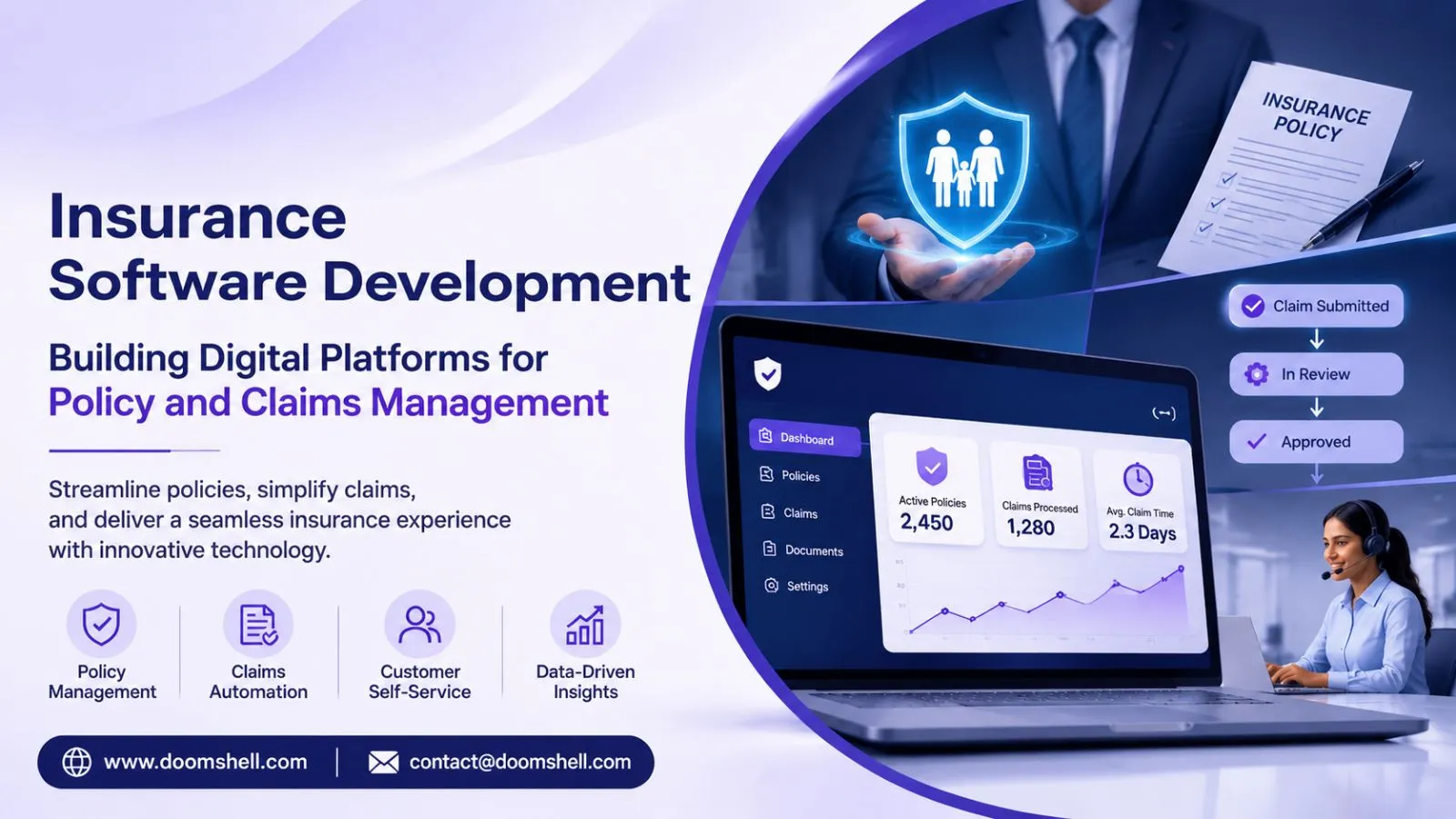
Building Digital Insurance Platforms for Customers
Insurance Software Development helps insurers unify services in one secure digital platform. They want to view policies, download documents, pay premiums, update details, and track claims without repeated calls. A connected portal can bring these services together while giving insurers a consistent view of customer interactions.
When choosing an software development company in India, businesses should look beyond the website interface. The platform must connect customer services with policy records, internal teams, payments, and reliable data. Laravel provides a structured PHP framework for building these application components around specific business rules.
Building Customer Portals With Laravel
A customer portal gives policyholders a secure place to manage their insurance. Depending on the product, users can view active policies, download certificates, check premium due dates, submit service requests, upload claim documents, and review communication history. A dashboard reduces the need to navigate separate systems.
Laravel supports portal development through organized routes, controllers, validation, database models, and reusable components. Developers can create distinct experiences for policyholders, corporate customers, agents, and service teams. Responsive design is essential because customers may use phones, tablets, or desktops.
Successful implementation begins with process mapping. Insurers should identify customer journeys, policy types, service teams, data sources, and approval rules before development starts. This discovery phase helps define requirements, prioritize essential features, and avoid building disconnected screens. It also gives developers a basis for estimating integrations, testing needs, and future enhancements.
Creating Policy Management Interfaces
Policy management interfaces help customers and employees review coverage throughout the policy lifecycle. Common details include insured assets, exclusions, beneficiaries, policy documents, premium schedules, and renewal dates. The interface should distinguish current information from historical changes.
Custom interfaces can reflect an insurer's products and approval rules. Laravel modules can apply validation when users request changes. An address update, for example, may follow a simpler process than a change to insured value or coverage.
Developing Personalized Insurance Dashboards
Personalized dashboards show policyholders the information that matters to them, such as upcoming payments, renewal reminders, claim progress, and relevant documents. Business customers may need consolidated views across multiple policies, locations, or insured assets.
Personalization must respect account permissions and customer preferences. A dashboard should not expose sensitive information when devices or accounts are shared. It can also explain next steps, identify missing documents, and show understandable status descriptions.
Insurance Software Development for Policy and Claims Workflows
Policy administration and claims handling involve many steps, documents, checks, and decisions. When teams depend on email chains or disconnected spreadsheets, delays and inconsistent records can increase. Workflow automation assigns responsibility, records progress, and gives employees an operational view.
In 2026, insurers are exploring AI to classify documents, summarize information, support triage, and assist employees with routine tasks. Recent industry analysis reports AI use expanding across underwriting, distribution, customer engagement, and claims, while insurers retain human oversight for consequential decisions.
Building Claims Management Systems With Laravel
A claims management system coordinates registration, document collection, assessment, approval, settlement, and communication. Customers or agents can submit a claim, provide evidence, and follow progress. Internal teams can review the case, request information, record decisions, and manage settlement tasks.
Laravel can structure claim records, status changes, document uploads, notifications, and task assignment. Each claim type may need different rules. Motor claims may require repair estimates, while health claims may need treatment records and provider details. Configurable workflows accommodate these differences.
Automating Policy Renewal Processes
Renewal automation identifies policies approaching expiry and starts customer communication at the right time. A platform can send reminders, present renewal terms, collect updated information, and guide customers through payment. It can route cases for review when underwriting checks or coverage changes are required.
Laravel can schedule renewal jobs, trigger email or SMS notifications, and update task queues based on policy dates. Messages should explain deadlines, premium changes, and required actions. Customer communication preferences and consent must be respected, and failed notifications should be recorded for follow-up.
Managing Approval Workflows With Laravel
Insurers often need approvals for underwriting exceptions, endorsements, claims, refunds, and policy changes. A workflow can assign requests according to product rules, value thresholds, department, or employee authority. It can also define what happens when information is missing or a review is delayed.
Laravel business logic can enforce approval stages and permissions. A request might move from an operations executive to a supervisor and then to a specialist, depending on risk or value. Notifications, task queues, and audit logs make responsibilities visible.
Connecting Insurance Applications With APIs
Insurance platforms exchange information with payment providers, identity services, brokers, healthcare networks, repair partners, accounting tools, and CRM systems. APIs allow applications to share information without employees re-entering the same data. A clear integration strategy defines data ownership, validation rules, and recovery steps when a service is unavailable.
Laravel can expose REST endpoints, consume external APIs, process queued jobs, and transform data between systems. This helps insurers connect customer-facing applications with operational services while keeping core business logic organized.
Building Insurance APIs With Laravel
Insurance APIs allow mobile apps, portals, broker systems, and partner platforms to exchange policy and claims information. Common functions include customer verification, policy lookup, premium quotations, claim submission, document status, and payment confirmation. Each endpoint needs a defined purpose and data contract.
Laravel provides routing, request validation, resource formatting, and authentication options. Laravel Sanctum supports token-based authentication for first-party applications and API consumers, while Passport can be suitable when OAuth2 capabilities are required. The choice depends on the integration model and security needs.
Integrating Payment and Verification Services
Payment integrations let customers pay premiums, renew policies, and receive transaction confirmations. A reliable implementation must handle successful payments, declines, pending transactions, refunds, duplicate callbacks, and reconciliation. A browser redirect alone should never be treated as proof of payment.
Identity and document verification services can support onboarding, customer updates, and claims checks. Depending on the provider, they may validate submitted details, verify documents, or return risk indicators. The platform should explain what information is collected and provide a route for resolving failed or disputed checks.
Connecting Laravel Applications With Third-Party Systems
Integrations can connect policy administration with CRM, accounting, broker management, document storage, communication, and analytics platforms. However, they depend on consistent identifiers, agreed data formats, and clear record ownership.
An integration layer can translate between systems and isolate the core application from vendor changes. Laravel queues can process slower tasks, while scheduled jobs synchronize records at defined intervals. Real-time events are useful when immediate updates matter, such as payment confirmation or claim assignment.
Protecting and Scaling Insurance Platforms
Insurance applications store personal details, financial records, policy documents, and claims evidence. A security incident can affect customers, operations, and trust. Security must be considered during architecture and development, while scalability matters as policy volumes and integrations grow.
Insurance technology priorities in 2026 include cyber resilience, trusted data use, AI governance, and connected digital ecosystems. Munich Re and ERGO's 2026 trend radar identifies data and AI, cybersecurity, and digital trust as important areas shaping insurers' decisions.
Implementing Role-Based Access With Laravel
Role-based access control limits users to the information and functions required for their responsibilities. Policyholders should see their own records, agents their assigned customers, and adjusters the claim evidence they need. Administrative access should remain restricted and monitored.
Laravel policies and gates can centralize authorization rules. Permissions must be checked on the server for every sensitive operation, not merely hidden in the interface. Access should be reviewed when employees change roles or leave. Least-privilege access reduces the impact of compromised accounts.
Building Secure Authentication Workflows
Authentication confirms a user's identity before granting access. Depending on risk and user type, platforms may support strong passwords, multi-factor authentication, email verification, single sign-on, or secure API tokens. Account recovery also needs protection because weak reset processes can undermine login security.
Laravel provides authentication building blocks and supports integration with identity providers. Its starter kits include common authentication features, while passkeys and single sign-on can be introduced through supported services.
Scaling Laravel Applications for Growing Policy Volumes
As an insurer grows, its platform may need to handle more customers, policies, claims, documents, and partner requests. A scalable design separates business modules, reduces unnecessary dependencies, and lets high-demand components expand independently. This makes it easier to add products or channels without rebuilding the entire application.
Laravel applications can use database indexing, query optimization, caching, queues, and scheduled processing to improve performance. Large uploads and report generation can run asynchronously. Monitoring should track response times, queue backlogs, database load, and error rates.
Doomshell helps businesses plan and develop digital solutions that support connected workflows, secure application experiences, and evolving operational needs. Its expertise includes Laravel-based portals, business applications, API integrations, and scalable web platforms. Through its Laravel development services, insurance providers can build customized applications that streamline business processes, improve data management, and support smoother digital interactions. As an IT company, Doomshell focuses on practical requirements, maintainable architecture, and reliable user experiences to help insurance businesses adapt to changing operational demands.