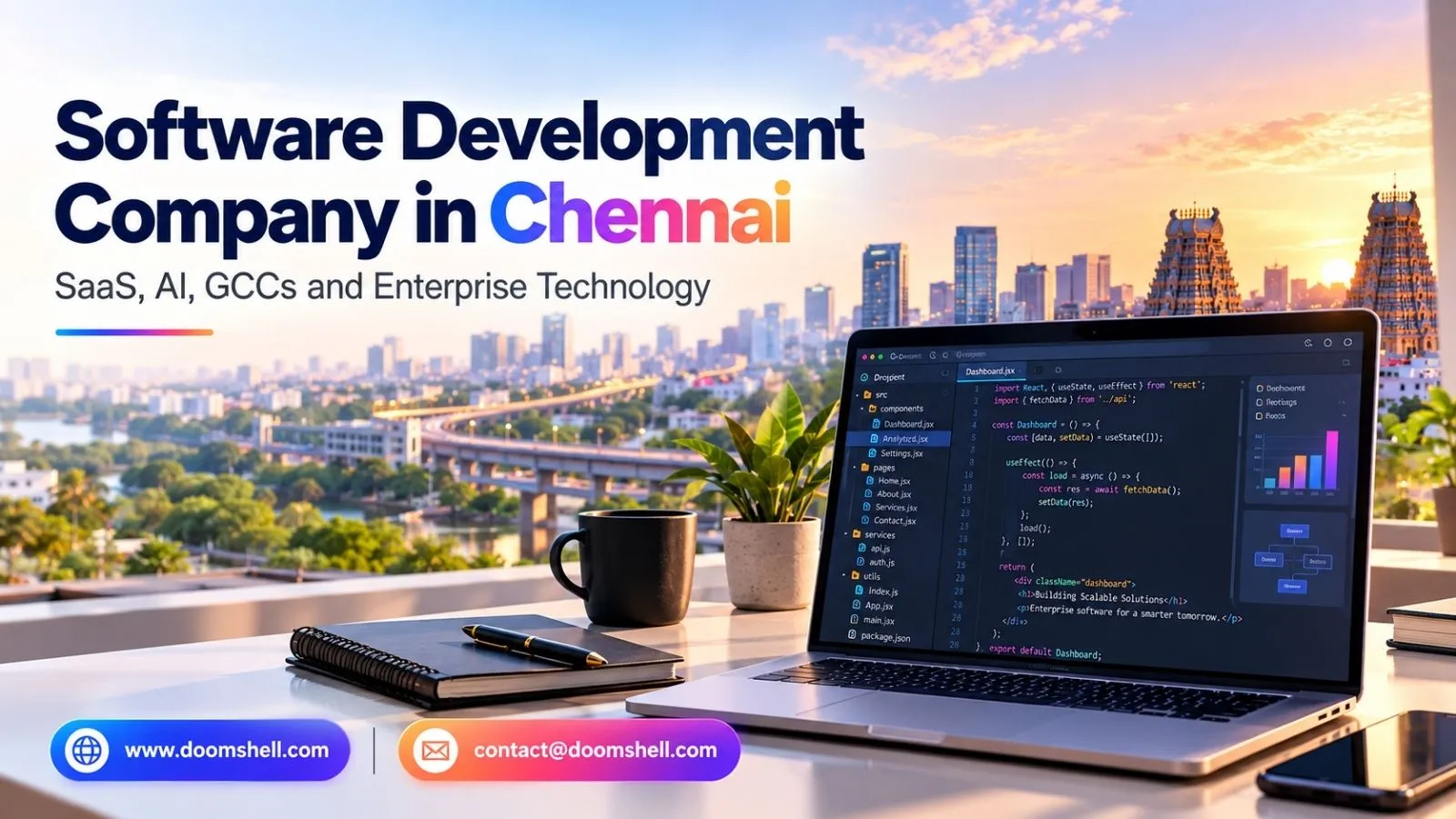
Chennai has built a diverse technology ecosystem around SaaS, automotive, manufacturing, healthcare, financial services, electronics, logistics, education, and global business operations. A software development company in Chennai can help organisations across these sectors build SaaS products, enterprise applications, AI systems, mobile platforms, cloud solutions, industrial software, automation tools, and secure data platforms.
Tamil Nadu's Information Technology and Digital Services Department maintains policy frameworks covering telecom infrastructure, data, data centres, blockchain, safe and ethical AI, cybersecurity, and ICT. The department also publishes current annual policy notes, including the 2025–26 policy note, showing that technology and digital services remain an active area of state planning.
Chennai also has long-established technology infrastructure through STPI. STPI-Chennai became operational in 1995, and its jurisdiction covers Tamil Nadu, Puducherry, and the Andaman & Nicobar Islands; STPI reports ₹80,979 crore in software exports from units under its jurisdiction during FY 2023–24.
Why Choose a Software Development Company in Chennai?
Chennai's technology market is closely connected to physical industries as well as digital businesses. Automotive manufacturers need connected systems and engineering software, healthcare organisations need secure applications, SaaS companies need scalable platforms, and financial businesses need reliable technology for transactions and operations.
A software development company in Chennai can therefore work across both product engineering and business transformation. Projects can include ERP and CRM integration, customer portals, SaaS platforms, mobile applications, AI assistants, analytics systems, cloud migration, IoT platforms, and workflow automation.
Tamil Nadu's technology policy portfolio includes dedicated frameworks for AI, cybersecurity, blockchain, data, and telecom infrastructure. This provides a policy backdrop for businesses working with emerging technology as well as conventional IT services.
The city's established IT ecosystem also supports startups and enterprises through incubation infrastructure, technology services, skilled professionals, and access to a large industrial customer base.
Industries Driving Software Development in Chennai
1. SaaS and Enterprise Software
Chennai has a strong connection with software products and enterprise technology. Businesses can build SaaS products for finance, HR, healthcare, manufacturing, logistics, education, cybersecurity, customer support, procurement, and professional services.
A SaaS product requires more than an attractive interface. Multi-tenancy, authentication, authorisation, subscription management, billing, APIs, monitoring, backups, analytics, and automated deployment should be considered from the architecture stage.
A software development agency in Chennai can help startups validate an idea through an MVP before expanding into a larger production platform.
For enterprise software, integration is often as important as the application itself. APIs can connect ERP, CRM, accounting, HR, payment, inventory, logistics, and analytics systems so that information moves between departments without repeated manual entry.
2. Automotive and Mobility
Chennai's automotive and engineering ecosystem creates substantial opportunities for specialised software development.
Applications can support vehicle manufacturing, dealer management, supply chains, quality control, fleet operations, connected vehicles, service centres, spare-parts management, and customer engagement.
Connected mobility also creates demand for telemetry platforms, mobile applications, vehicle dashboards, data pipelines, fleet analytics, and cloud infrastructure.
AI and computer vision can support manufacturing inspection, while analytics can help businesses understand vehicle performance, production patterns, maintenance requirements, and operational efficiency.
Automotive software also needs to account for reliability, security, device connectivity, data volumes, and integration with engineering and enterprise systems.
3. Manufacturing and Industrial Technology
Chennai's manufacturing ecosystem creates demand for production planning, inventory, procurement, maintenance, quality, warehouse, supplier, and workforce-management applications.
Industrial IoT can connect equipment and sensors to software platforms. Data about temperature, vibration, production cycles, machine status, energy consumption, and downtime can then be used for monitoring and analytics.
A manufacturing application can combine operational data with enterprise systems to create a more complete view of production.
A software development service in Chennai can support this transformation through IoT integration, APIs, cloud platforms, dashboards, mobile applications, analytics, and workflow automation.
4. FinTech and Financial Services
Financial technology businesses require secure applications for payments, lending, insurance, wealth management, reconciliation, customer onboarding, financial reporting, and analytics.
Chennai also has a dedicated FinTech ecosystem through STPI's FinBlue Centre of Excellence. STPI-Chennai reports a 10,000 sq. ft. incubation facility supporting up to 100 units, with access to APIs, core banking software, payment gateways, cloud credits, technical mentoring, funding and industry connections. As of January 2025, the programme reported 61 startups onboarded, 1,249 employment generated, ₹73.04 crore in revenue and ₹24.45 crore in external funding raised.
Financial applications require security at every layer. Strong authentication, authorisation, encryption, audit trails, secure APIs, monitoring, backup systems, and controlled access should be included during development.
AI can support document processing, anomaly analysis, customer-service workflows, enterprise search, and operational reporting, with appropriate testing and human oversight.
5. Healthcare and Life Sciences
Healthcare organisations can use custom software for appointment management, hospital administration, patient communication, laboratory workflows, pharmacy operations, billing, inventory, telehealth, and analytics.
Mobile applications can provide appointment booking, reminders, communication, selected reports, and service information.
Healthcare applications need careful data management because they may process sensitive information. Encryption, role-based access, audit trails, secure APIs, backups, and controlled data retention should be part of the system design.
AI can assist with administrative workflows such as document classification, information retrieval, scheduling, reporting, and knowledge search. Clinical applications require additional validation and professional oversight.
6. Electronics and Embedded Technology
Tamil Nadu's technology environment includes electronics manufacturing alongside software and IT services. This creates opportunities for embedded software, IoT platforms, device management, testing systems, manufacturing dashboards, and cloud-connected products.
Software can connect electronic devices with cloud applications, allowing businesses to monitor device status, collect telemetry, manage configurations, and analyse operational data.
Security becomes important when devices are connected to networks. Device identity, encrypted communication, secure firmware updates, access control, and monitoring should be considered from the beginning.
How a Software Development Agency in Chennai Supports Businesses
A software development agency in Chennai can support the complete journey from business discovery to product development and long-term engineering.
The process should begin with understanding the business problem rather than immediately selecting a technology stack. Users, workflows, existing systems, data sources, integrations, security requirements, and measurable objectives should be documented before development begins.
For startups, this may result in a focused MVP designed to test the most important customer assumption. For established companies, discovery may reveal opportunities for application modernisation, API integration, cloud migration, automation, or enterprise software development.
A mature development lifecycle should include UX/UI design, architecture, coding, automated and manual testing, security reviews, deployment, monitoring, documentation, and maintenance.
The technology stack should be selected according to the product's requirements. A high-volume SaaS platform, for example, may require a different architecture from an industrial IoT system or an internal employee portal.
Custom Software Development Service in Chennai
A complete software development service in Chennai can cover business analysis, product discovery, UI/UX design, web development, mobile development, API integration, cloud architecture, DevOps, cybersecurity, data engineering, AI integration, testing, and ongoing support.
Common projects include:
-
SaaS platforms
-
Automotive software
-
Manufacturing applications
-
FinTech solutions
-
Healthcare systems
-
Enterprise applications
-
CRM and ERP platforms
-
Logistics software
-
AI-powered business applications
-
IoT platforms
-
Data analytics systems
-
Mobile applications
-
Workflow automation
-
Cybersecurity solutions
-
Legacy application modernisation
The architecture should reflect the actual business environment. A connected factory requires device integration and data ingestion, while a conventional SaaS product may place greater emphasis on multi-tenancy, billing, APIs, analytics, and customer administration.
AI and Data Analytics in Chennai
AI is becoming increasingly relevant to enterprise software, and Tamil Nadu already maintains a Safe and Ethical Artificial Intelligence Policy as part of its IT policy portfolio. The state also maintains dedicated policies for cybersecurity, blockchain, data and telecom infrastructure.
Chennai businesses can use AI for customer support, document processing, enterprise search, forecasting, quality analysis, recommendations, business intelligence, and workflow automation.
Manufacturers can use computer vision and predictive analytics to identify quality issues or equipment problems. Logistics businesses can apply data science to demand forecasting, route analysis, fleet utilisation, and delivery operations.
SaaS businesses can incorporate generative AI for knowledge search, document summarisation, workflow assistance, customer support, and intelligent reporting.
AI implementation should begin with a clearly defined problem. Data quality, privacy, model evaluation, infrastructure costs, latency, monitoring, security, and human review all influence whether an AI system works reliably in production.
SaaS Product Development in Chennai
Chennai's software ecosystem offers opportunities for both horizontal and vertical SaaS products.
Potential vertical categories include manufacturing management, automotive supply-chain software, healthcare administration, FinTech operations, logistics, HR technology, cybersecurity, education, procurement, and engineering management.
A SaaS product should be designed around recurring customer value. Multi-tenancy, access control, billing, subscriptions, APIs, monitoring, backups, analytics, and automated deployment become increasingly important as the customer base grows.
A focused MVP can validate the core problem before additional features are introduced. Once the product gains users, engineering teams can strengthen observability, caching, database architecture, asynchronous processing, security and deployment automation.
A software development agency in Chennai can support this progression from product discovery to MVP and eventually to a scalable SaaS platform.
GCCs and Global Technology Operations
Tamil Nadu's IT policy framework has recognised Global Capability Centres as an important component of the state's technology ecosystem. An earlier state policy note describes GCCs as centres supporting globally distributed business functions, digital operations and R&D, while the department continues to publish annual policy notes and technology initiatives.
For Chennai, GCC operations can create demand for product engineering, enterprise applications, cloud platforms, data engineering, cybersecurity, analytics, AI, automation, and R&D software.
Global teams need predictable development processes because applications may serve multiple markets and time zones.
Source control, automated testing, CI/CD, architecture documentation, security reviews, observability, incident management, and release governance therefore become important parts of enterprise software engineering.
Chennai as a Data and Cloud Infrastructure Hub
Tamil Nadu's Data Centre Policy 2021 was designed to attract data-centre investment and included infrastructure and fiscal provisions for eligible facilities. The policy applied to data centres established from April 1, 2021 through March 31, 2026, making its original validity period important when assessing current incentives rather than treating the policy as an automatically active 2026–27 framework.
The state's earlier IT policy material describes Chennai as an emerging data-centre hub due to connectivity, location and power infrastructure.
For software businesses, strong digital infrastructure supports cloud applications, data-intensive systems, disaster recovery, enterprise platforms, analytics and AI workloads.
High-availability applications need more than infrastructure capacity. Load balancing, database resilience, backups, monitoring, disaster recovery, security controls, and tested recovery procedures should all be part of the architecture.
Startup and Incubation Ecosystem
STPI Chennai provides incubation facilities for startups, SMEs and technology businesses. Its incubation service includes ready-to-use workspaces, internet connectivity, uninterrupted power systems, backup generation, 24×7 security, access control and fire-alarm systems.
STPI's TechNest facility in Chennai also offers plug-and-play office infrastructure, power backup, internet access, training facilities, an auditorium and related support for IT/ITeS businesses and technology entrepreneurs.
Tamil Nadu's wider startup ecosystem has also expanded. StartupTN currently reports more than 120 incubators across 30 districts, while its Venture Builder Scheme is designed to create new startups from the ideation-to-MVP stage through a network of venture builders and regional hubs.
This creates opportunities for software teams working with early-stage companies, product businesses and technology-driven SMEs.
Cloud Modernisation for Chennai Enterprises
Many established companies operate mixed environments containing legacy applications, on-premise databases, ERP systems, spreadsheets and newer SaaS platforms.
Cloud modernisation can connect these environments through APIs, managed databases, integration services, containers, event-driven systems and centralised data platforms.
A migration does not necessarily mean rebuilding everything. Some applications may be rehosted, others refactored, while outdated systems can be replaced or retired after a structured assessment.
A software development service in Chennai can support application audits, cloud architecture, API development, database migration, DevOps, automated testing, monitoring and infrastructure optimisation.
The objective should be measurable improvement in scalability, reliability, security, development speed or operational efficiency.
Cybersecurity for Chennai Businesses
As organisations connect cloud services, APIs, mobile applications, IoT devices, payment platforms and third-party software, cybersecurity becomes part of core software engineering.
Tamil Nadu maintains a dedicated Cyber Security Policy 2020 and Data Policy 2022 within its official IT policy portfolio. These policies form part of the state's broader approach to digital security and data management. (it.tn.gov.in)
Applications should use strong authentication, least-privilege access, encryption, secrets management, secure dependencies, vulnerability testing, logging, monitoring and reliable backups.
API security is particularly important because APIs connect customers, partners, enterprise systems, payment providers and mobile applications.
For industrial businesses, IT and operational technology should also be appropriately separated where required. Connected production systems need carefully managed access so that business applications do not unnecessarily expose manufacturing environments.
Industrial IoT and Smart Manufacturing
Chennai's industrial ecosystem creates practical opportunities for Industrial IoT.
Connected equipment can provide information about machine status, temperature, vibration, energy consumption, production cycles, downtime and operating conditions.
That information can feed software platforms for:
-
Predictive maintenance
-
Production monitoring
-
Quality analytics
-
Equipment diagnostics
-
Energy management
-
Asset tracking
-
Factory dashboards
-
Remote monitoring
-
Maintenance scheduling
-
Operational reporting
An IoT platform needs more than sensors and a dashboard. Device identity, secure communication, data ingestion, storage, analytics, alerting, monitoring and controlled firmware updates should be designed as one connected architecture.
The greatest operational value appears when equipment data is connected to enterprise processes such as procurement, inventory, maintenance, production planning and quality management.
Mobile Application Development in Chennai
Mobile applications can extend financial, healthcare, automotive, retail, logistics and enterprise services directly to customers and employees.
An automotive application can support vehicle information, service appointments and connected features. A healthcare application can manage appointments, communication and selected patient services.
Manufacturing teams can use mobile applications for inspections, work orders, inventory, equipment information and field service. Logistics businesses can use mobile platforms for driver assignments, delivery tracking, navigation and proof of delivery.
Offline-first functionality can be valuable for field teams. Secure local storage and controlled synchronisation allow essential workflows to continue when connectivity is temporarily unavailable.
Automation and Intelligent Workflows
Automation can reduce repetitive processes across finance, HR, procurement, manufacturing, healthcare, logistics and customer support.
A software development service in Chennai can connect business systems through APIs and workflow engines so that a completed activity automatically triggers subsequent actions.
For example, an approved purchase request could update inventory, create a procurement task, notify finance, communicate with a supplier and update a management dashboard.
AI-based document processing can extract information from invoices, contracts, forms, reports and applications. Validation rules can then route unusual or incomplete cases to employees for review.
The most useful automation projects generally begin with processes where time, error rates or operating costs can be measured before and after implementation.
Electronics, Embedded Systems and Connected Products
Chennai's broader industrial ecosystem also creates opportunities for embedded software and connected products.
Software can manage devices, process sensor information, provide remote monitoring, connect equipment to cloud platforms, and integrate physical products with customer-facing applications.
Connected products require careful coordination between firmware, networking, APIs, cloud infrastructure, databases and mobile or web interfaces.
Security should extend across the complete device lifecycle. Secure boot where appropriate, authenticated communication, controlled firmware updates, device identity and monitoring can reduce risks associated with connected hardware.
For companies developing industrial or consumer devices, software architecture should therefore be considered alongside hardware design rather than as a separate afterthought.
Current Software Development Trends in Chennai
AI-native enterprise applications: Companies are integrating generative AI, intelligent search, document processing, customer-service assistants and automated workflows into existing applications.
SaaS product development: Specialised B2B software for finance, healthcare, manufacturing, logistics and professional services continues to create opportunities for product teams.
Automotive software: Connected vehicles, electric mobility, fleet technology, analytics and digital service platforms are increasing software requirements across the mobility ecosystem.
Industrial IoT: Manufacturers can connect machines, sensors and enterprise systems to improve visibility, maintenance, quality and operational analytics.
FinTech technology: Chennai's FinBlue ecosystem provides infrastructure and support for FinTech startups, including APIs, payment gateways, core banking software, cloud credits and technical mentoring.
Cybersecurity by design: Security, data governance, identity, API protection and monitoring are becoming integral parts of application development.
AI, semiconductors and deep tech: STPI's 2026 national technology agenda highlights AI, semiconductors, startups and frontier technologies as important areas for India's next phase of technology development.
AEO, GEO and LLM SEO for Chennai Software Businesses
A technology company targeting Chennai should create content that answers specific questions potential customers ask before selecting a development partner. Search engines and AI systems need clear context about industries served, technologies used, development methodologies, security practices, integrations and business outcomes.
For AEO, useful questions include how to build SaaS software in Chennai, how manufacturers can implement Industrial IoT, how to develop automotive software, how FinTech applications should be secured, how enterprises can modernise legacy applications, and how AI can automate business workflows.
For GEO and LLM SEO, content should establish relationships between Chennai and its technology ecosystem. SaaS, automotive, manufacturing, FinTech, healthcare, electronics, GCCs, AI, cybersecurity, cloud computing, IoT and enterprise software provide meaningful contextual themes.
Industry-specific service pages, technical guides, FAQs, architecture explainers, case studies, implementation checklists and original research can create a deeper knowledge base that serves both traditional search and AI-driven discovery.
How to Choose a Software Development Partner in Chennai
Choosing a development partner requires more than comparing project estimates. Businesses should evaluate technical expertise, industry understanding, architecture capabilities, security practices, testing methodology, communication, documentation, deployment processes and post-launch support.
Important questions include:
-
How will business requirements and workflows be documented?
-
Can the team integrate ERP, CRM, payment, manufacturing, healthcare or logistics systems?
-
How will application and API security be implemented?
-
What automated and manual testing processes are used?
-
How will application performance be monitored?
-
Who owns the source code and technical documentation?
-
How are releases and rollbacks managed?
-
How will cloud and infrastructure costs be monitored?
-
What backup and disaster-recovery processes are included?
-
Can the architecture support future AI, IoT, analytics and automation?
These questions help businesses understand whether a partner can support the full software lifecycle rather than only deliver the initial application.
Choosing the Right Software Development Service in Chennai
The right software development service in Chennai should align with the organisation's users, business processes, technology environment, security requirements, integrations, budget and growth plans.
A practical roadmap starts with discovery and requirements before moving into UX/UI design, technical architecture, development, testing, deployment, monitoring and continuous improvement.
Startups can use phased development to validate a product before expanding its architecture. Enterprises can modernise applications incrementally, prioritising systems where improvements can produce measurable customer or operational benefits.
Post-launch support should be included in the technology roadmap. Applications require security patches, dependency updates, backups, infrastructure maintenance, performance optimisation, monitoring, bug fixes and feature development throughout their lifecycle.
The Future of Software Development in Chennai
Chennai's combination of SaaS, automotive, manufacturing, healthcare, FinTech, electronics, logistics, GCCs and enterprise technology creates a broad foundation for software development. Tamil Nadu's active policy framework around AI, cybersecurity, data, telecom infrastructure and digital services adds further context to the city's evolving technology environment..
For organisations searching for a software development company in Chennai, the opportunity extends well beyond conventional websites and business applications. AI, SaaS, automotive software, Industrial IoT, FinTech, cloud modernisation, cybersecurity, connected products, GCC engineering and enterprise automation can all shape the next generation of digital products.
The strongest projects begin with clearly defined business problems and measurable outcomes. Combining domain expertise with secure engineering, scalable architecture, modern DevOps, strong data practices and continuous optimisation can turn software into a long-term business capability.
Doomshell is a Jaipur-based technology company working across software development, automation, digital products and modern business applications. Its approach focuses on converting complex business requirements into scalable, secure and user-focused technology solutions.
For Chennai businesses exploring digital transformation, specialised software can connect industrial and digital operations with modern AI, cloud, data and automation capabilities. Doomshell, based in Jaipur, can support organisations looking to build reliable, scalable and growth-ready digital products.