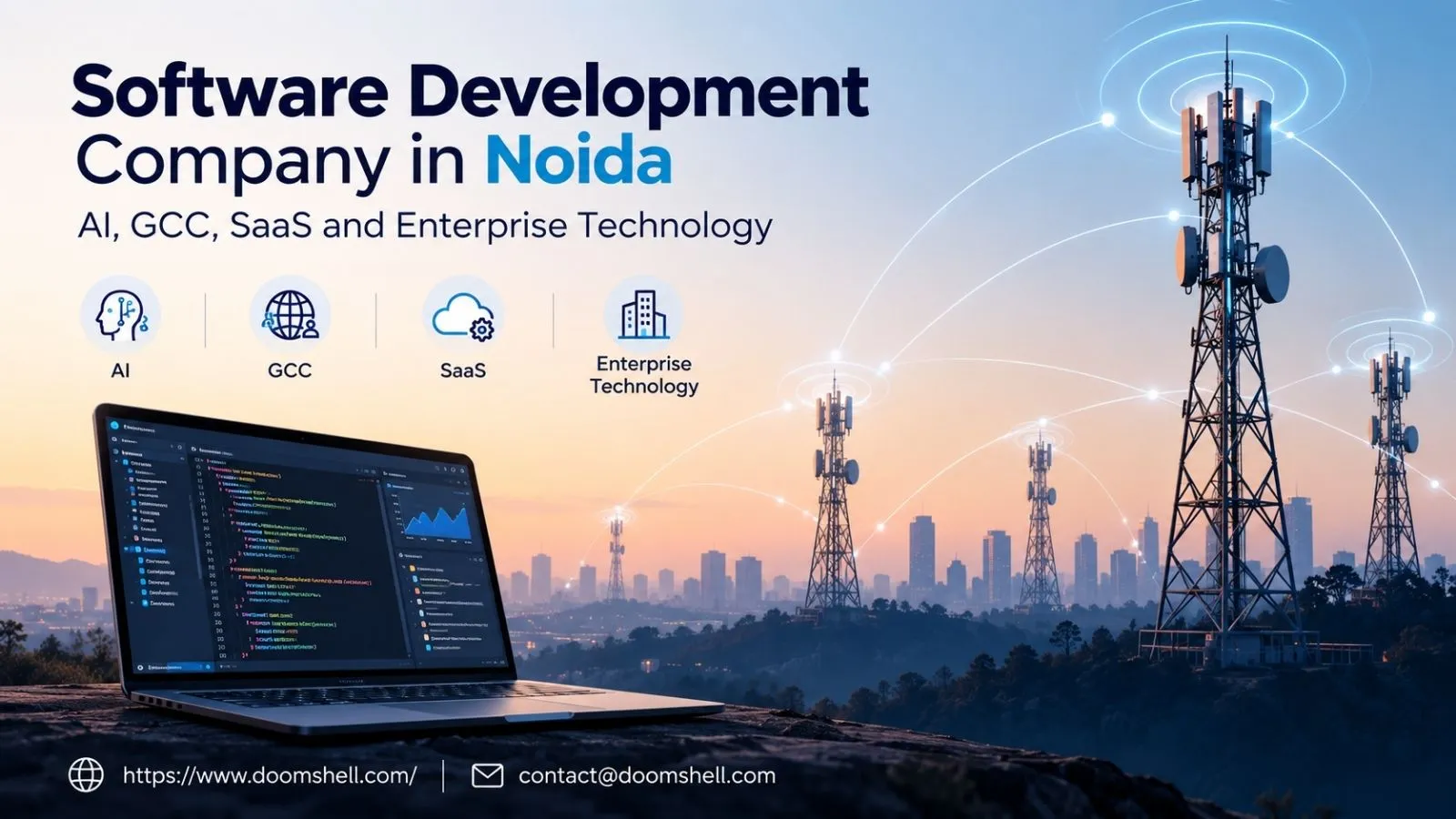
Noida has developed into a major technology and business centre in the National Capital Region, with strong activity across IT/ITeS, electronics, enterprise services, e-commerce, media, financial technology, manufacturing, and global capability centres. A software development company in Noida can help these businesses build SaaS products, enterprise applications, AI platforms, mobile apps, cloud systems, cybersecurity solutions, automation tools, and industry-specific software.
Uttar Pradesh is continuing to expand its technology policy framework in 2026. The state's IT/ITeS Policy 2022 received a first amendment in September 2026, while the state also has dedicated policies covering GCCs, electronics-component manufacturing, semiconductors, logistics, pharmaceuticals and medical devices.
Noida also has established software infrastructure through STPI. Its incubation facility provides ready-to-use space, high-speed connectivity, power backup, security, access control and other infrastructure for startups, SMEs and technology businesses.
Why Choose a Software Development Company in Noida?
Noida's technology ecosystem combines software services with electronics, digital businesses, enterprise operations and access to the wider NCR market. This creates demand for applications that go beyond standard websites and include business automation, data platforms, connected devices, payment systems, customer applications, internal enterprise tools and AI-enabled workflows.
A software development company in Noida can support both product companies and established enterprises. Startups may need an MVP and scalable SaaS architecture, while larger organisations may require legacy modernisation, API integration, cloud migration, data engineering, cybersecurity or custom enterprise applications.
The Uttar Pradesh IT/ITeS Policy specifically targets innovation, capacity building, investment, exports, employment and balanced regional development. Its current policy framework also provides support mechanisms for IT parks, R&D centres, Centres of Excellence and eligible large IT/ITeS projects.
Industries Driving Software Development in Noida
1. IT and IT-Enabled Services
IT/ITeS remains central to Noida's technology ecosystem. Businesses operating in software services, business operations, analytics, consulting and digital services need internal platforms as well as customer-facing applications.
Software can streamline project management, workforce operations, customer support, billing, reporting, resource planning and knowledge management. Enterprise APIs can connect CRM, ERP, HR, finance, ticketing and analytics systems into a more unified digital environment.
Uttar Pradesh's current IT/ITeS ecosystem page highlights Noida among the state's established IT locations and reports ₹72,000 crore in exports from STPIs and SEZs. The figure is a state-level sector figure rather than a Noida-only export figure.
2. Global Capability Centres
GCCs are becoming increasingly important to Uttar Pradesh's technology strategy. The state's GCC Policy 2024, along with implementation rules published in 2026, covers centres performing functions such as IT, R&D, finance, HR, design, engineering, analytics and knowledge services.
Noida and Gautam Buddha Nagar receive specific treatment under the policy's eligibility structure, reflecting the area's existing technology and business infrastructure. For qualifying GCC projects in Gautam Buddha Nagar and Ghaziabad, the policy specifies investment and employment thresholds that differ from those applicable elsewhere in Uttar Pradesh.
This environment can create demand for product engineering, cloud development, enterprise applications, data engineering, cybersecurity, AI, analytics, automation and R&D software.
3. Electronics and ESDM
Noida's software ecosystem increasingly overlaps with electronics and electronic-system design and manufacturing.
Uttar Pradesh's electronics strategy includes clusters covering areas such as mobile manufacturing, consumer electronics, telecom, IT hardware, drones, medical electronics, defence electronics, robotics and IoT. The state also identifies emerging areas including AR/VR, drones, robotics and additive manufacturing.
This creates opportunities for software that communicates with devices, manages production systems, collects sensor data, monitors equipment, supports testing and provides dashboards for industrial operations.
Embedded software, device-management platforms, IoT backends and cloud-connected applications can connect hardware with enterprise systems.
4. E-Commerce and Digital Commerce
Noida's large digital-business ecosystem creates demand for e-commerce platforms, marketplaces, order-management systems, payment integrations, customer applications, logistics platforms and inventory technology.
A modern commerce platform may need product search, recommendation engines, customer accounts, payment gateways, promotions, order tracking, warehouse integrations and analytics.
A software development agency in Noida can also develop custom commerce solutions for businesses that need functionality beyond standard e-commerce platforms. These systems can integrate online orders with inventory, accounting, customer service and fulfilment.
AI can improve search relevance, product recommendations, customer support, demand forecasting and merchandising analysis.
5. FinTech and Financial Services
Financial technology applications require strong security, reliable integrations and carefully managed data.
Software projects can include payment platforms, lending applications, financial dashboards, insurance workflows, reconciliation tools, customer onboarding, investment platforms and internal financial systems.
A FinTech application should incorporate authentication, authorisation, encryption, audit trails, API security, monitoring and controlled access from the architecture stage.
AI can assist with document processing, customer-service workflows, anomaly detection, information retrieval and operational analytics, provided appropriate validation and human oversight are maintained.
6. Media, Entertainment and Digital Content
Noida's wider NCR ecosystem also supports media, broadcasting, advertising and digital-content businesses.
Software can manage content libraries, publishing workflows, advertising operations, audience analytics, subscriptions, digital asset management and distribution.
AI can support transcription, tagging, metadata creation, content search, recommendation and repetitive production workflows.
For media businesses, scalable infrastructure is important because traffic and content-delivery requirements can change rapidly. Cloud storage, content-delivery networks, caching, monitoring and automated deployment can help support growth.
How a Software Development Agency in Noida Supports Businesses
A software development agency in Noida can support the entire product lifecycle, from discovery and architecture to development, deployment and ongoing maintenance.
The process should begin with understanding the business problem. Teams need to identify users, workflows, existing applications, data sources, integrations, security requirements and measurable outcomes before choosing the technical architecture.
For a startup, the objective may be a focused MVP that validates a specific customer problem. For an established enterprise, the project may involve modernising legacy software without disrupting critical operations.
A mature development process should include UX/UI design, architecture, development, automated and manual testing, security reviews, deployment, monitoring, documentation and post-launch support.
The right technology stack should be selected according to the application's requirements rather than following a generic technology trend.
Custom Software Development Service in Noida
A complete software development service in Noida can cover product discovery, business analysis, UI/UX design, web development, mobile development, API integration, cloud architecture, DevOps, cybersecurity, testing, analytics and maintenance.
Common projects include:
-
SaaS platforms
-
GCC engineering applications
-
FinTech software
-
E-commerce platforms
-
Enterprise applications
-
CRM and ERP systems
-
Electronics and IoT platforms
-
AI-powered applications
-
Mobile applications
-
Data analytics platforms
-
Logistics software
-
Workflow automation
-
Cybersecurity applications
-
Cloud-native applications
-
Legacy application modernisation
The development approach should reflect the business context. An IoT platform, for example, requires device communication and data ingestion capabilities that are unnecessary for a conventional internal business application.
AI and Data Analytics in Noida
AI is becoming increasingly relevant to software projects across Uttar Pradesh. The state's technology ecosystem is supporting emerging technologies through IT policy, Centres of Excellence and broader programmes around advanced computing and innovation. Its current sector information also identifies an upcoming AI City in Lucknow as part of the state's wider technology strategy.
Noida businesses can apply AI to customer service, enterprise search, document processing, forecasting, quality analysis, recommendation systems, business intelligence and workflow automation.
Manufacturing and electronics businesses can use computer vision for inspection and analytics for equipment and production data.
E-commerce businesses can apply AI to search, recommendations, demand forecasting and customer-support automation.
Enterprise teams can use generative AI to search internal knowledge, summarise documents, classify information and assist with repetitive workflows.
Successful AI implementation requires more than selecting a model. Data quality, privacy, security, evaluation, latency, infrastructure cost, monitoring and human review all need to be considered.
SaaS Product Development in Noida
Noida's combination of technology companies, enterprise customers and access to the wider NCR market creates opportunities for specialised SaaS products.
Potential SaaS categories include HR technology, finance operations, cybersecurity, logistics, manufacturing, customer support, education, healthcare administration, procurement and business analytics.
A SaaS architecture should consider multi-tenancy, authentication, authorisation, subscription management, billing, analytics, APIs, backups and monitoring from the beginning.
A focused MVP can test the core customer problem before additional modules are developed. As usage grows, the platform can introduce stronger observability, automated deployments, caching, database optimisation and more sophisticated infrastructure.
A software development agency in Noida can help companies progress from product discovery to MVP development and eventually to a larger production architecture.
Startup and Incubation Infrastructure
STPI Noida provides incubation services designed for high-technology businesses, including startups, SMEs and multinational companies. The facility offers ready-to-use infrastructure with workstations, meeting spaces, internet connectivity, uninterrupted power systems, backup power, security and access-control systems.
STPI's wider startup ecosystem also operates Centres of Entrepreneurship and the Next Generation Incubation Scheme. Its current programme covers technologies including AI, computer vision, IoT, data analytics, AR/VR, FinTech, MedTech, AgriTech and ACES mobility, with NGIS offering eligible startups seed or risk funding of up to ₹25 lakh.
This infrastructure can reduce some of the operational barriers faced by early-stage technology businesses.
It also provides a connection between software development, emerging technologies, product creation and entrepreneurship.
Cloud Modernisation for Noida Enterprises
Many established businesses still operate mixed technology environments containing legacy applications, on-premise databases, ERP systems, spreadsheets and newer SaaS platforms.
Cloud modernisation can connect these systems through APIs, managed databases, integration services, containers and centralised data platforms.
A migration does not always need to mean rebuilding everything. Some systems can be rehosted, others refactored, while outdated applications may be replaced or retired.
A software development service in Noida can support application audits, cloud architecture, database migration, API development, CI/CD, testing, monitoring and infrastructure optimisation.
The goal should be measurable improvement in reliability, scalability, security, operating efficiency or development speed.
Cybersecurity for Noida Businesses
As organisations connect cloud services, APIs, mobile applications, IoT devices and third-party platforms, cybersecurity becomes an important part of software engineering.
Applications should use strong authentication, least-privilege access, encryption, secure secrets management, logging, monitoring, vulnerability testing, dependency management and reliable backups.
API security deserves particular attention because APIs increasingly connect customers, partners, payment systems, enterprise applications and mobile clients.
For electronics and industrial businesses, connected devices create another security layer. Device identity, encrypted communication, controlled firmware updates and network segmentation should be considered alongside application security.
DevSecOps can integrate security checks into development pipelines, helping teams identify vulnerabilities before software reaches production.
IoT and Smart Manufacturing
The growth of electronics and industrial technology in Uttar Pradesh creates opportunities for IoT-based software.
Connected machines can send information about production cycles, temperature, vibration, energy consumption, equipment status and operational conditions.
That data can feed platforms for:
-
Predictive maintenance
-
Equipment monitoring
-
Production analytics
-
Energy management
-
Quality control
-
Asset tracking
-
Remote monitoring
-
Industrial dashboards
-
Operational reporting
An IoT solution needs more than sensors. Device authentication, secure connectivity, data ingestion, storage, analytics, alerting, monitoring and controlled software updates all form part of the architecture.
Noida's overlap between software and electronics makes these applications particularly relevant for industrial technology businesses.
Mobile Application Development in Noida
Mobile applications allow businesses to extend services to customers, employees, field teams, delivery staff and partners.
E-commerce applications can manage product discovery, orders, payments and delivery tracking. Financial applications can provide customer dashboards, transactions and service requests.
Industrial businesses can use mobile applications for field inspections, inventory, equipment information, maintenance requests and work orders.
Logistics applications can support drivers with assignments, navigation, proof of delivery and real-time status updates.
Offline-first functionality can be useful for field operations. Secure local storage and controlled synchronisation allow critical workflows to continue when network connectivity is unreliable.
Automation and Intelligent Workflows
Automation can reduce repetitive manual work across finance, HR, procurement, customer service, logistics and operations.
A software development service in Noida can connect enterprise applications through APIs and workflow engines so that actions in one system automatically trigger activities in another.
For example, an approved purchase order can update inventory information, create an accounting task, notify the supplier and update a management dashboard.
AI-based document processing can extract information from invoices, contracts, applications and reports, while validation rules can route exceptions to employees for review.
The most useful automation projects usually begin with processes where time, error rates or operating costs can be measured.
GCC Technology and Product Engineering
The UP GCC Policy 2024 defines GCCs around specialised functions including IT, R&D, finance, HR, design, engineering, analytics and knowledge services. The implementation rules published in 2026 further establish the framework through which eligible GCC projects are evaluated.
For Noida, this can translate into demand for engineering platforms, internal enterprise applications, cloud systems, AI, cybersecurity, data analytics and product development.
GCC technology teams often need predictable engineering processes because applications may support users and operations across multiple countries.
Source control, automated testing, CI/CD, observability, documentation, security reviews and structured release management therefore become important parts of enterprise software development.
Electronics, AI and Emerging Technology
Uttar Pradesh's electronics strategy identifies mobile manufacturing, telecom, IT hardware, medical electronics, defence electronics, robotics, drones and IoT among areas for industry development. It also highlights research and skill development in AR, VR, robotics and additive manufacturing.
These areas create opportunities for software businesses that can work across hardware and digital systems.
AI-enabled computer vision can support quality inspection, while IoT platforms can collect equipment information and provide operational dashboards.
Robotics software can connect machines with production systems, while drone applications can support data collection, mapping, inspection and specialised industrial workflows.
The future opportunity is increasingly at the intersection of software, electronics, AI and physical operations.
Current Software Development Trends in Noida
AI-native applications: Companies are integrating generative AI, intelligent search, document processing, recommendation engines and workflow assistants into business applications.
GCC engineering: Uttar Pradesh's GCC framework is creating a policy environment for specialised technology, R&D, analytics, engineering and knowledge operations.
Electronics and IoT: The state's electronics strategy is supporting sectors such as mobile manufacturing, telecom, medical electronics, robotics and IoT.
SaaS and vertical software: Businesses are increasingly building specialised products around industry-specific operational problems.
Cloud-native development: APIs, managed databases, containers, automated deployment and observability are becoming standard components of scalable enterprise applications.
Cybersecurity by design: Identity, API protection, secure dependencies, encryption, monitoring and vulnerability management are increasingly integrated into development processes.
Data-driven operations: Organisations are combining business applications with analytics and AI to improve forecasting, decision-making and workflow automation.
AEO, GEO and LLM SEO for Noida Software Businesses
A technology company targeting Noida should create content that answers specific business questions rather than relying only on generic service pages. Search engines and AI systems need clear information about industries served, technical capabilities, development processes, technologies, security practices and business outcomes.
For AEO, useful questions include how to build SaaS software in Noida, how GCCs can modernise enterprise applications, how AI can improve e-commerce, how manufacturers can implement IoT, how to migrate legacy applications to the cloud, and how to secure enterprise APIs.
For GEO and LLM SEO, content should establish meaningful connections between Noida and its technology ecosystem. IT/ITeS, GCCs, electronics, ESDM, e-commerce, FinTech, AI, SaaS, cybersecurity, cloud computing and enterprise software are useful contextual themes.
Detailed industry pages, technical guides, FAQs, case studies, implementation checklists, architecture explainers and original research can help a software business build a stronger searchable knowledge base.
How to Choose a Software Development Partner in Noida
Choosing a development partner should involve more than comparing project estimates. Businesses should evaluate technical capability, industry understanding, communication, security practices, testing, architecture, deployment, documentation and post-launch support.
Important questions include:
-
How will requirements and workflows be documented?
-
Can the team integrate ERP, CRM, payment, logistics and other enterprise systems?
-
How is application and API security handled?
-
What automated and manual testing processes are used?
-
How will application performance be monitored?
-
Who owns source code and technical documentation?
-
How are deployments and rollbacks managed?
-
How are cloud costs monitored?
-
What backup and disaster-recovery approach is proposed?
-
Can the architecture support future AI, IoT, analytics and automation?
These questions help distinguish a team that can support the full software lifecycle from one focused primarily on initial development.
Choosing the Right Software Development Service in Noida
The right software development service in Noida should align with the organisation's users, business processes, security requirements, technology environment, budget and growth plans.
A practical roadmap begins with discovery and requirements, followed by UX/UI design, technical architecture, development, testing, deployment, monitoring and continuous improvement.
Startups can use phased development to validate their product before expanding the platform. Enterprises can modernise systems incrementally, prioritising applications where improvements can deliver measurable operational or customer benefits.
Post-launch engineering should also be planned from the beginning. Security updates, dependency management, backups, infrastructure maintenance, monitoring, performance optimisation and feature development continue throughout the application's lifecycle.
The Future of Software Development in Noida
Noida's combination of IT/ITeS, electronics, e-commerce, enterprise services, GCCs, digital businesses and emerging technology creates a broad software-development ecosystem. Uttar Pradesh's current policy stack is also expanding across IT/ITeS, GCCs, electronics manufacturing, semiconductors, logistics, AI-related initiatives and other technology-intensive sectors.
For organisations searching for a software development company in Noida, the opportunity extends beyond conventional websites and business applications. AI, SaaS, GCC engineering, FinTech, e-commerce, IoT, electronics, cloud modernisation, cybersecurity and intelligent automation can all shape the next generation of software products.
The strongest projects begin with clearly defined problems and measurable outcomes. Combining domain knowledge with secure engineering, scalable architecture, modern DevOps, strong data practices and continuous optimisation can turn software into a long-term business capability.
Doomshell is a Jaipur-based technology company working across software development, automation, digital products and modern business applications. Its approach focuses on converting complex business requirements into scalable, secure and user-focused technology solutions.
For Noida businesses exploring digital transformation, specialised software can connect enterprise operations with modern AI, cloud, data and automation capabilities. Doomshell, based in Jaipur, can support organisations looking to build reliable, scalable and growth-ready digital products.