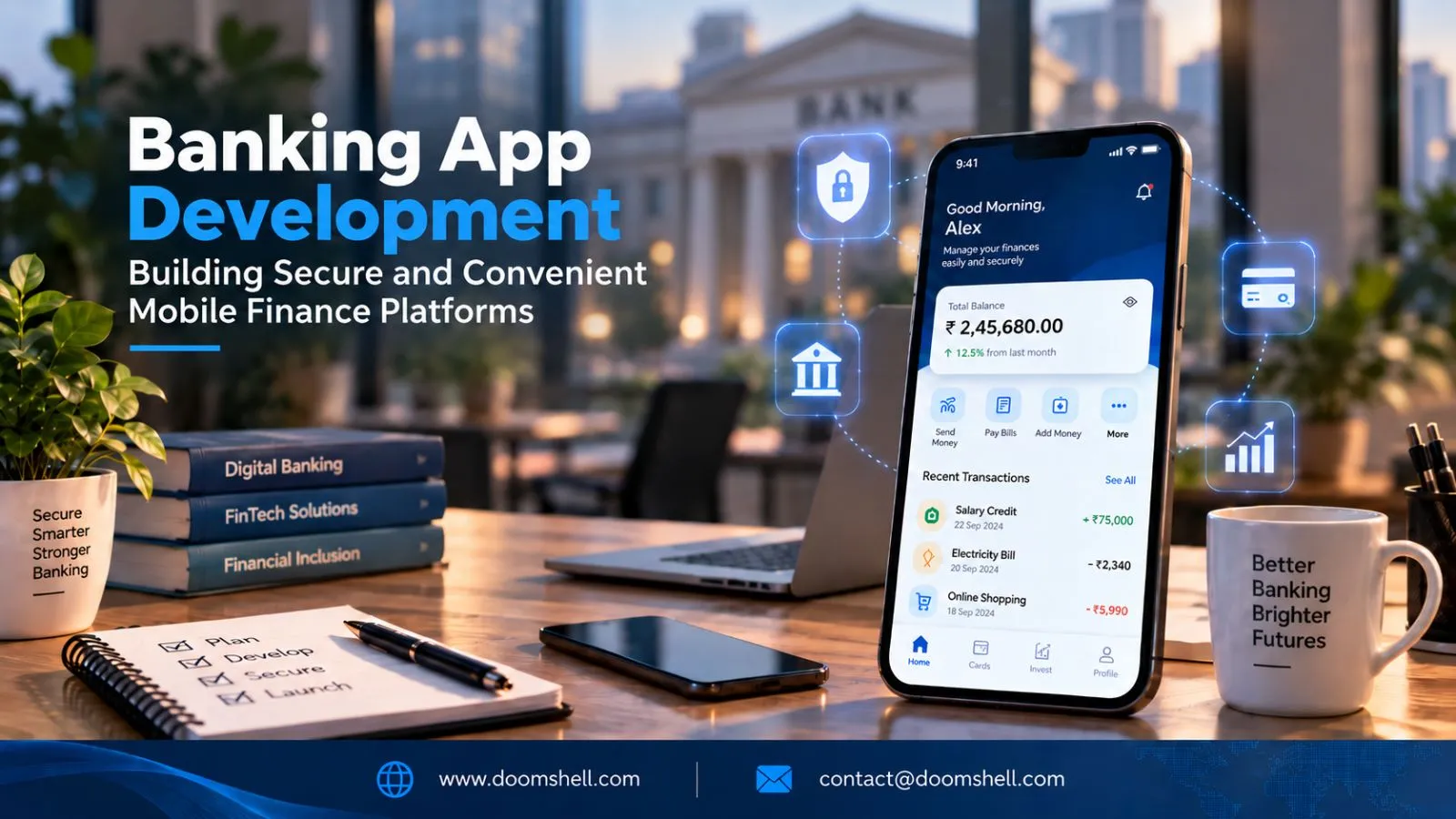
Modern financial platforms need to process large volumes of sensitive data while delivering fast transactions, reliable automation, strong security, and actionable financial intelligence.
In 2026, Python remains a practical technology for financial applications because it can connect backend services, data pipelines, machine learning models, APIs, and automation workflows within a flexible development ecosystem.
Building Digital Banking and Financial Applications
Financial applications need a reliable backend capable of handling customer accounts, transactions, balances, permissions, and integrations with external financial systems.
FinTech software development can provide the application layer that connects these services while maintaining clear business rules and strong controls around financial data.
Developing Banking Backends With Python
Python can be used to build backend services for digital banking, lending, payments, investment platforms, and other financial applications.
A banking backend may manage:
-
Customer accounts
-
Transactions
-
Beneficiaries
-
Payment instructions
-
Account balances
-
Financial documents
-
Notifications
-
User permissions
The backend should remain the source of truth for important financial operations. Mobile or web clients should request actions through controlled APIs rather than directly modifying financial records.
Python's broad ecosystem also makes it possible to connect conventional business logic with data processing, analytics, and machine learning services.
Creating Account and Transaction Management Systems
Transaction management requires more than creating a record when a customer initiates a payment.
A financial transaction may move through multiple states:
Initiated → Authenticated → Validated → Processing → Completed
It may also fail, expire, be reversed, or require additional verification.
A robust system should model these states explicitly and maintain an auditable history of important changes.
Database transactions, idempotency controls, validation rules, and reconciliation processes can help prevent inconsistent financial records.
For example, if a customer retries the same payment because of a network interruption, an idempotent backend can recognize the request instead of creating an unintended duplicate transaction.
Building Financial APIs With Python
APIs provide the communication layer between financial applications and their clients, partners, payment providers, analytics services, and internal systems.
A Python-based API can expose controlled services for:
-
Account information
-
Transaction history
-
Payment initiation
-
Customer verification
-
Financial reporting
-
Risk evaluation
-
Notifications
API architecture should include authentication, authorization, validation, rate limiting, monitoring, version management, and audit logging.
Financial APIs should also follow the principle of least privilege by returning only the information required for a specific application or workflow.
Automating Financial Operations
Many financial operations involve repetitive data movement and validation. Automating these processes can reduce manual effort while making workflows more consistent and traceable.
Automating Reports and Financial Workflows With Python
Python can automate the collection, transformation, validation, and presentation of financial information.
A reporting workflow might:
Collect data → Validate records → Transform information → Calculate metrics → Generate report → Deliver securely
This can support daily transaction reports, financial summaries, exception reports, operational dashboards, and management analytics.
Background processing is particularly useful for large reports because intensive calculations do not need to block customer-facing application requests.
Building Automated Reconciliation Systems
Reconciliation compares records from different financial systems to identify whether transactions and balances match.
For example, a FinTech platform may compare internal transaction records against payment-provider settlements or bank statements.
An automated reconciliation system can classify records as:
-
Matched
-
Partially matched
-
Missing
-
Duplicated
-
Amount mismatch
-
Requires manual review
Instead of simply reporting that records do not match, the system can provide an exception queue for finance teams.
This creates a structured process for resolving discrepancies and maintaining a reliable financial ledger.
Developing Data Processing Pipelines With Python
Financial platforms can process large quantities of structured and unstructured data from transaction systems, payment providers, customer applications, compliance workflows, and external services.
Python can orchestrate pipelines that clean, validate, transform, enrich, and route this information.
A production pipeline should also consider data lineage and quality.
Teams should be able to understand where an important financial data point originated, which transformations were applied, and which downstream systems consumed it.
This becomes particularly valuable when financial data feeds reporting, risk analysis, or machine learning models.
Supporting Risk and Fraud Analysis
Fraud detection and financial risk analysis increasingly depend on the ability to process transaction patterns quickly.
AI and machine learning can supplement traditional rules-based systems by identifying patterns that may be difficult to detect manually.
Using Python for Fraud Detection Systems
A fraud detection platform can evaluate transactions using multiple signals.
These might include:
-
Transaction amount
-
Transaction frequency
-
Device information
-
Geographic patterns
-
Account behavior
-
Historical activity
-
Login patterns
-
Payment relationships
Python can provide the data-processing and machine learning layer for these systems.
A transaction could receive a risk score that determines the next workflow:
Low risk → Process normally
Medium risk → Additional verification
High risk → Hold or escalate for review
The model should not automatically be treated as infallible. Thresholds, business rules, monitoring, and human review can be combined to manage uncertain cases.
Building Risk Analysis Applications With Python
Financial risk applications can help organizations evaluate credit, transaction, portfolio, operational, or customer-related risk.
A risk platform can combine historical information with current activity to produce indicators for authorized users.
For example, a lending application might combine customer information, repayment history, transaction behavior, and other approved signals to support a risk assessment.
The application should clearly distinguish raw financial information, model-generated predictions, and final business decisions.
This improves transparency and makes it easier to audit how an outcome was reached.
Developing Predictive Financial Models
Predictive models can help financial businesses forecast outcomes such as:
-
Customer churn
-
Cash-flow requirements
-
Payment defaults
-
Transaction anomalies
-
Demand for financial products
-
Portfolio behavior
Python's machine learning ecosystem makes it possible to build, evaluate, deploy, and monitor these models within broader financial platforms.
However, predictive performance should be continuously evaluated. A model that performs well on historical data can behave differently when customer behavior, economic conditions, product rules, or fraud patterns change.
Production systems should therefore monitor model performance and support controlled retraining and version management.
Connecting Financial Platforms With APIs
Modern FinTech applications rarely operate as isolated systems. They need to exchange information with payment processors, banks, identity services, accounting platforms, CRM systems, data providers, and other financial infrastructure.
Integrating Payment APIs With Python
Payment APIs can enable financial applications to initiate transactions, process payment events, retrieve transaction information, and receive status updates.
A robust integration should not assume that every external request succeeds immediately.
Payment states can include:
Created → Authorized → Processing → Completed
with additional paths for failures, reversals, disputes, or cancellations.
Webhooks can notify the platform about external events, while idempotency prevents repeated callbacks or retries from creating duplicate operations.
External API responses should also be validated before being used to update internal financial records.
Building Secure Financial Data Services
Financial APIs can expose highly sensitive information, making security a fundamental part of the service architecture.
Important controls include:
-
Strong authentication
-
Fine-grained authorization
-
Encryption in transit
-
Secure secret management
-
Rate limiting
-
Input validation
-
Audit trails
-
Token expiration
-
API monitoring
-
Data minimization
Authentication should not be confused with authorization. Knowing who is making a request does not automatically mean that the user can access every financial resource.
The backend should verify authorization for each sensitive operation.
API security guidance also identifies risks such as broken object-level authorization, broken authentication, unrestricted resource consumption, and unsafe consumption of third-party APIs. (owasp.org)
Developing Scalable Python Microservices
Large FinTech platforms may eventually separate major capabilities into independently deployable services.
For example:
Customer Service → Account Service → Transaction Service → Risk Service → Notification Service → Reporting Service
Python microservices can be scaled independently according to workload.
Transaction processing may require consistently available resources, while reporting workloads may run periodically in the background.
However, microservices should not be introduced simply because they are popular. For smaller platforms, a well-structured modular application can be easier to operate and maintain.
The architecture should reflect actual business and workload requirements.
Building Real-Time Financial Workflows
Financial systems increasingly need to respond to events as they occur.
A transaction event can trigger several downstream operations:
Transaction completed → Update account view → Record event → Evaluate risk → Send notification → Update reporting data
An event-driven architecture can separate these responsibilities and prevent one slow operation from blocking the core transaction workflow.
Python services can use queues and asynchronous processing for notifications, reconciliation, data enrichment, reporting, and machine learning workloads.
This is particularly useful when transaction volumes increase because background workloads can be scaled independently.
Designing FinTech Platforms for AI and Automation
AI is becoming an additional layer within financial applications.
Beyond fraud detection and predictive modeling, businesses can use AI for document extraction, financial information retrieval, customer-service assistance, transaction categorization, and operational analysis.
For example, an internal financial assistant could retrieve authorized transaction information and generate a concise summary for a finance employee.
The underlying application still needs strict access controls. An AI system should not automatically gain access to every financial record available to the platform.
For sensitive financial workflows, AI-generated information should remain distinguishable from verified financial records and should include appropriate human-review paths.
Securing and Scaling Financial Software
FinTech platforms require security controls across application code, databases, APIs, infrastructure, integrations, and user devices.
A scalable security architecture can include:
-
Multi-factor authentication
-
Role-based access
-
Encryption
-
Secure API gateways
-
Secrets management
-
Transaction monitoring
-
Audit logging
-
Vulnerability testing
-
Backup and disaster recovery
-
Continuous monitoring
Performance also requires attention to database indexing, caching, queue processing, connection management, API optimization, and infrastructure scaling.
Financial systems should be designed so that increased transaction volume does not compromise data consistency or operational visibility.
Conclusion
FinTech software development is enabling financial businesses to build connected platforms that combine digital banking, transaction processing, automation, risk analysis, fraud detection, predictive modeling, and API-driven financial services.
Python provides a flexible foundation for these capabilities because the same ecosystem can support backend services, data processing, machine learning, automation, and API development.
The strongest financial platforms are designed around reliability and control as much as functionality. Transactions need clear states, APIs need strong authorization, automated workflows need auditability, and machine learning systems need continuous evaluation.
For FinTech businesses building new financial products in 2026, combining secure application architecture with data-driven services and carefully governed automation can create platforms that are easier to scale, integrate, and evolve as financial requirements change.